


Secretariat Sweeps to Triple Crown
- 5 days ago
- 3 min read

A Day in History - 9th June 1973
At the 105th running of the Belmont Stakes, a bumper crowd of 69,138 witnessed something they would never forget. Secretariat didn't just win - he romped to victory by an improbable margin of 31 lengths, crossing the wire at 2.24, a course record that still stands. It was the final leg of a sweep through the Kentucky Derby and the Preakness Stakes, making Secretariat the first Triple Crown winner in 25 years.
Secretariat was born at Meadow Stable in Virginia in 1970. A bright-red chestnut colt, he was quickly dubbed 'Big Red' by stable hands. On her first inspection of the foal, Penny Chenery (then Tweedy) made a one-note entry into her notebook - "Wow". It proved prophetic. Horsebreeder Seth Hancock later commented;
"You want to know who Secretariat is in human terms? Just imagine the greatest athlete in the world. The greatest. Now make him six-foot-three, the perfect height. Make him real intelligent and kind. And on top of that, make him the best-lookin' guy ever to come down the pike. He was all those things as a horse."
What nobody knew at the time was that Secretariat was built differently. A post-mortem in 1989 revealed a heart estimated to be nearly three times the size of a normal thoroughbred's.

Before the Triple Crown campaign even began, Chenery had been forced to syndicate Secretariat for a then-record $6.08 million to cover an inheritance tax bill on the family estate - a remarkable vote of confidence for a horse yet to prove himself at the highest level. Then the colt stumbled in his final Derby prep race - the Wood Memorial - finishing third. His stockier, sprinter's build raised further doubts on his calibre. Sham had also proved himself a formidable rival that most sportwriters believed capable of breaking many records himself. They were right. He just had the misfortune of running against Secretariat.

The Kentucky Derby drew the largest crowd in North American racing history at the time - 134,476 assembled at Churchill Downs. Sham began well, made his move at the half-mile and hit the front heading into the final furlong. Secretariat, starting in last place as was his habit, came charging through and battled with Sham, eventually pulling away to win by 2½ lengths and a track record of 1:59⅗, that still stands today. Sham broke the old record too. He just couldn't break Secretariat.
The Preakness told the same story. Breaking last, Secretariat executed an immaculate first turn sweep from back to front. Sham challenged briefly, but Secretariat drew clear again and won by another 2½ lengths, setting another course record of 1.53.
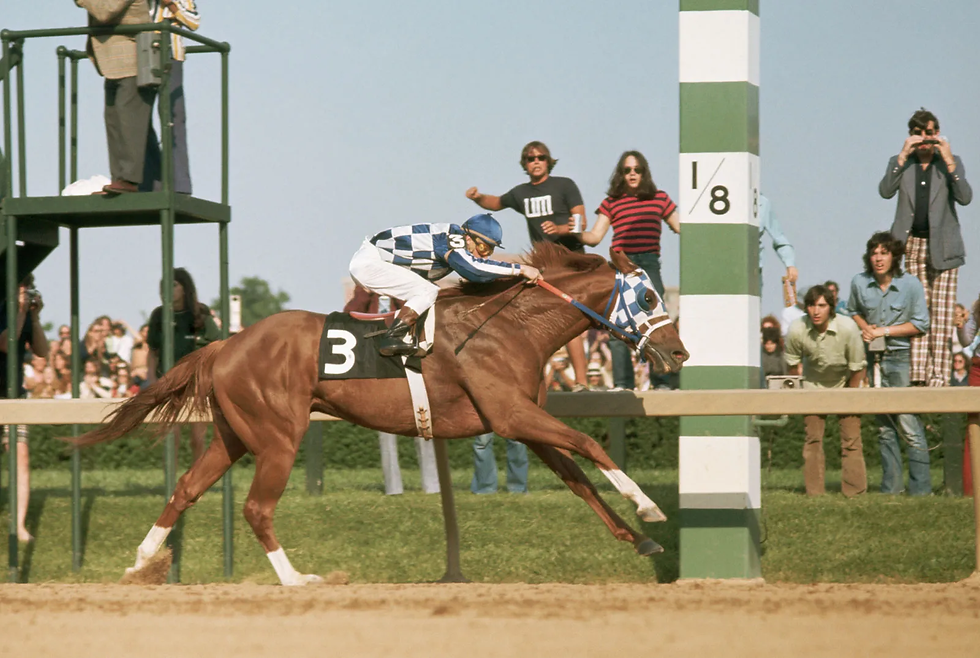
Then came Belmont on a warm and sunny June 9. Only four rivals, including Sham, dared take on Big Red. The moment the gates opened, it was over. Secretariat exploded clear and never came back to the field - a 31-length winner, the fastest mile-and-a-half on dirt ever run in America. Turcotte said afterwards he "just let him run his own way". His own way was good enough to shatter the Belmont record by over 2 seconds.
Sham, the horse who might have been a legend in another era, finished dead last. Weeks later, he was diagnosed with a cannon bone fracture, an injury his trainer believed had begun at Belmont. He never raced again. He wasn't just beaten that day. He was broken.
The reaction was unanimous. Chenery called him "wonderful". Trainer Lucien Laurin when asked if Secretariat was the best horse he'd ever seen, answered simply "positively". Turcotte called him the "greatest horse I ever rode". Rival jockeys reached for words like "superhorse" and "the best ever seen". At Belmont, as spectators ran out of words, the numbers said everything.
This superequine achievement made Secretariat a national celebrity. As writer William Nack observed, "Secretariat suddenly transcended horse racing and became some sort of natural phenomenon, a sort of undeclared national holiday away from the tortures of Watergate and the Vietnam War." At a time when America needed something to cheer, Big Red delivered. Over fifty years on, nobody has run quicker.




Comments