


Exercise Tiger: D-Day's Tragic Rehearsal
- Apr 28
- 3 min read
A Day in History - 28th April 1944
On 28 April 1944, a large-scale rehearsal for the Allied invasion of Nazi-occupied Europe turned into one of the deadliest training disasters of the Second World War. The operation, known as Exercise Tiger, took place at Slapton Sands, South Devon and was intended to simulate the conditions of the forthcoming D-Day landings on Normandy. Instead, it resulted in the deaths of at least 749 American servicemen, more than three times the number of Allied casualties in the assault on Utah Beach itself.
Slapton Sands was chosen because of its geographical similarity to Utah Beach, a gravel beach followed by a narrow strip of land, then a lake. To facilitate the exercise, 3000 local British residents were evacuated from Slapton for the duration of the rehearsals. In late April 1944, on board nine large LST (Landing Ship, Tanks), approximately 30,000 servicemen took part in a series of landing exercises that would culminate in the landing at Slapton Sands via Lyme Bay.

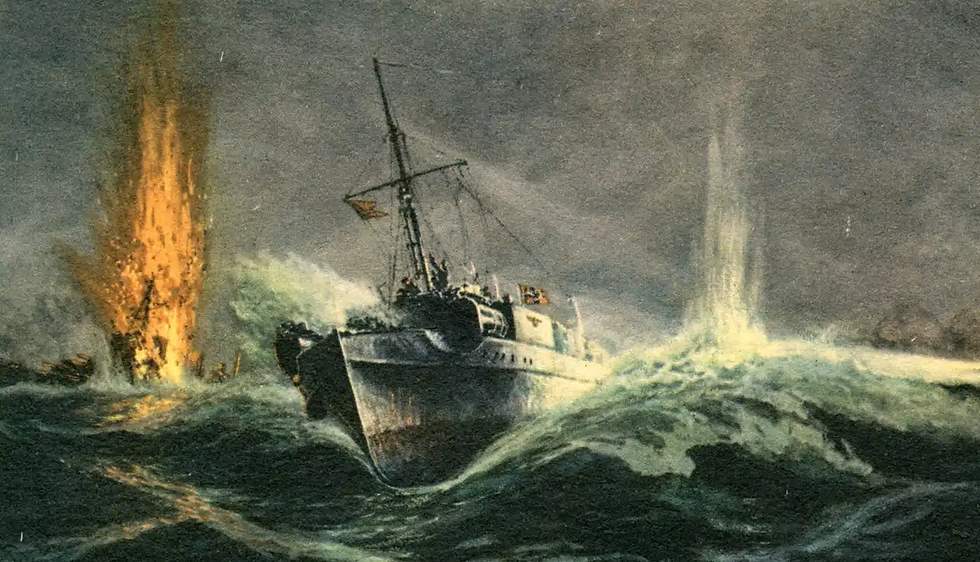
The disaster unfolded in the early hours of 28 April, when a convoy of LSTs, designated Convoy T-4, was intercepted by German fast attack craft, known as S-Boots, operating out of Cherbourg. A tragic combination of failures left the convoy dangerously exposed. A Royal Navy escort vessel had unknowingly remained in port for repairs, while typists had entered the wrong radio frequency, meaning the LST's were unaware of any danger. Thus, when German S-Boots stumbled upon the US convoy in the darkness, they were unguarded and unprepared.
Shortly after 2.00 am, the German S-Boots fired torpedoes into the slow-moving, lightly defended convoy. Two LST's were sunk and another was left severely damaged. Lieutenant Eugene E. Eckstam, on board one of the landing ships hit, remembered the sound of "crunching metal" as the ship's engine room was hit, followed by the "raging inferno" as the ship just "sat and burned". Many soldiers were ill-trained for this emergency and panicked as they abandoned ship. Some of them were still wearing their full packs when they jumped overboard, while improperly fastened lifebelts caused others to drown face down. With the water temperature around 5 - 6°C, hypothermia quickly claimed additional lives.

The disaster exposed serious operational weaknesses that required urgent correction before D-Day. Vice Admiral Alan Kirk, the Allied naval commander, recognised the vulnerability of landing craft to fast enemy vessels and pushed for intensified naval and aerial bombardment of German positions, particularly around Cherbourg, to neutralise the E-boat threat. Additional reforms included standardising radio communication protocols, improving lifejacket training and plans for small craft to pick up floating survivors on D-Day.
Despite the scale of the disaster, the details of Exercise Tiger were kept under a secrecy order issued by General Dwight D Eisenhower. For fear of compromising the success of the impending invasion and undermining morale of the troops heading to D-Day itself, the survivors and locals were told not to speak of the incident, the bodies disappeared, and relatives were kept in the dark. Laurie Bolton, whose uncle Sergeant Louis Archer Bolton died when his LST was hit by a torpedo, said: "We always knew my uncle had died in the English Channel prior to D-Day, but we never knew any details". They were warned "never to speak of it".
It was not until 1984 that wider attention was drawn to Exercise Tiger, largely due to the efforts of local historian Ken Small, who recovered a submerged Sherman tank from the seabed. Today, the restored tank now stands as a memorial near Slapton Sands, commemorating those who died in what Small described as a tragedy "never covered up; but conveniently forgotten".




Comments