


Zulu: The Defence of Rorke's Drift
- Jan 22
- 8 min read
A Day in History - 22nd January 1879
On the afternoon of the 22nd January 1879, a skeleton British garrison of fewer than 150 soldiers stood at Rorke’s Drift, an unremarkable mission station on the edge of Zululand. Within hours, they would be fighting for their lives. Just twelve miles away, an entire British column had been destroyed at Isandlwana - remembered by the Zulu as The Day of the Dead Moon, when a total eclipse darkened the battlefield. What followed at Rorke’s Drift would become one of the most desperate and brave defensive actions in British military history.
“Nothing Will Happen”
When dawn broke at Rorke's Drift, life at the mission station was calm, even dull. Private Henry Hook remembered that 'we were all knocking about and I was making tea for the sick.' For the men stationed there, the war felt distant. There was routine, boredom, and a sense of complete quiet, only broken up by the hustle and bustle of hundreds of men from the No.3 column passing through. As Hook reflected, little did they know 'that only a dozen miles away the very men we said ‘good luck’ to were either dead or standing back-to-back in a last fierce fight with the Zulus.' The defeat shattered the illusion of British invincibility and left the Natal frontier and Rorke’s Drift itself dangerously exposed.
Some time after noon, Rorke’s Drift’s commanding officer, Major Spalding, left the post in search of a missing Company. Before riding off, he reassured those left behind that “nothing will happen, and I shall be back in the early evening.”
Command was passed to Lieutenant John Chard of the Royal Engineers, alongside Lieutenant Gonville Bromhead of the 24th Regiment. Barely three hours later, fugitives from Isandlwana arrived in panic, shouting that “the camp has been taken by the enemy… all our men in it massacred.” Bromhead received the fateful communication note, 'that the enemy was coming on and the post was to be held at all costs'

Any doubts vanished. The Zulu army was coming to Rorke's Drift.
"A Worse Position Could Hardly Be Imagined"
The Rorke’s Drift mission station was an inherently poor defensive position. It covered an area no larger than three tennis courts and centred on a mission hospital and a stone storehouse. With no prepared fortifications, the defenders threw together makeshift barricades from wagons, boxes of army biscuits, mealie bags, and even 'barrels of rum and lime juice pressed into service.'

Captain Hallam Parr later summed it up bluntly, observing that 'a worse position could hardly be imagined', a testament to the courage and improvisation of the men who defended it. Gardens and orchards ran right up to the buildings, allowing attackers to approach within yards of the walls.
Most dangerously of all, the Oskarberg hill towered over the post. From its rocky terraces, Zulu marksmen could fire down into the position, and sniper fire from the hill would account for many of the garrison’s casualties.

The odds were bleak. Through desertion and redeployment, the garrison had been reduced from around 450 men to just 139, including 35 sick and wounded. Facing them were between 3,000 and 4,000 Zulu warriors, led by Prince Dabulamanzi. These men had not fought at Isandlwana and were eager for battle.

“Here They Come”
At around 3:30 p.m., Private Wall climbed the slopes of the Oskarberg and suddenly saw the advancing Zulu force. His warning rang out across the post: “Here they come - black as hell and thick as grass.”
Less than an hour later, at approximately 4:30 pm, the Zulu attack began, first exchanging inaccurate shots with Private Hitch from the Oskarberg. Around six hundred Zulu warriors then surged toward the southern wall between the hospital and the storehouse. The British held their fire until the Zulus were within 500 yards. Private Dunbar played a key role in breaking up the impetus of this first Zulu attack. A crack shot, Dunbar 'shot no fewer than nine Zulus', one of them being a 'chief on horseback'.

Private Hitch later recalled how the Zulus ‘attacked in the shape of a bullock’s horn and in a few minutes were all around us.’ Hook was also impressed by the excellent use of terrain by the attacking Zulus, recalling how 'they neglected nothing' and 'took advantage of only every bit of cover there was' including bushes and ant hills.

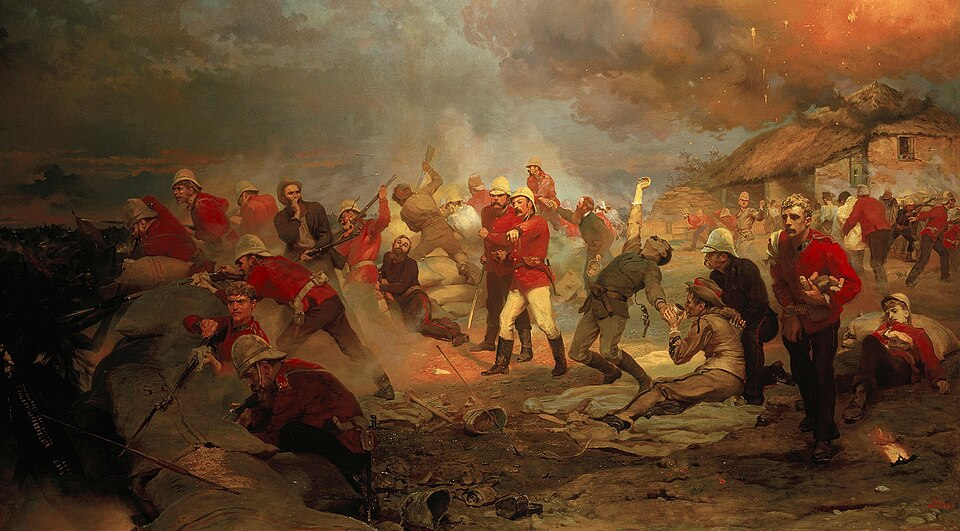
Along the barricades, savage hand-to-hand fighting broke out. Zulus crouched beneath the walls, thrusting assegais upward, trying to seize Martini–Henry rifles, or firing through gaps. After the initial volleys fired against the first wave of Zulu attackers, much of the fighting was at close quarters.
One account read that 'to show their fearlessness, they tried to leap the parapet, and at times seized our bayonets, to be shot down… one cannot but admire their fanatical bravery.' Hitch also noted that the bayonet had a powerful psychological effect, as the attackers showed a 'great dread of it.' Still, the pressure was relentless. Chard was forced to abandon the outer perimeter and fall back to a shorter second line of defence, a necessary move, but one that left the hospital isolated.
“Pinned Like Rats in a Hole”
It was inside the hospital that some of the most desperate and heroic moments of the battle unfolded.
At around 6:30 p.m., Chard ordered 'all the men inside the entrenchment,' leaving the hospital garrison cut off and facing the full weight of the Zulu assault. Among those trapped inside were Privates Henry Hook, John Williams, Joseph Williams, and Robert and William Jones.

With rifle ammunition running low, the defenders turned to revolvers and bayonets. Privates Horrigan, John Williams and Joseph Williams fought desperately to hold the hospital entrance. Joseph Williams defended a small window so effectively that fourteen Zulu bodies were later found piled beneath it before he himself was dragged out and killed. As Hook later recalled, 'to get out seemed impossible, for if we left the hospital in the only door which had been left open, we should instantly fall into the midst of the Zulus.' Cut off and surrounded, he summed up their situation aptly: 'we were pinned like rats in a hole.'
As the front of the hospital began to collapse, John Williams took an axe and started hacking escape holes through the interior walls. Bedridden patients were dragged from room to room as Zulus broke in behind them. Hook fought on as 'Zulu fire… erupted,' surviving an assegai strike to his helmet and escaping 'with a scalp wound.' In one encounter, he later recalled, 'A big Zulu sprang forward and seized my rifle and I tore it free, and slipping a cartridge in, I shot him point blank.'

The roof soon caught fire, a terrifying development, but one which later became a fatal mistake by the attackers. After nearly fifty minutes of fighting, the final breach in the hospital wall was made. Hook was the last man out, killing several Zulus before diving through the hole. From the final room, defended by Robert and William Jones, patients escaped through a window and ran the gauntlet across what became known as the 'courtyard of death.' Of the eleven patients pulled out, nine survived the trip to the barricade, as did every able-bodied defender.
"Last Stand"
The battle was far from over.
The defenders were forced to withdraw twice more, making their 'last stand' behind a wall adjoining the storehouse. As the fight continued, the Zulus, by setting the hospital roof on fire, had given the defenders a distinct tactical advantage as night fell. Sergeant Smith described how the burning hospital provided a terrible 'killing ground' as the Zulu attackers 'lighted themselves up in the lurid flames against the darkness.'
The Zulus' final phase of attack pushed towards the storehouse, which, if set on fire could have been disastrous and deprived the garrison of their last remaining area of shelter. Fortunately, all attacks failed. One intrepid Zulu was shot, just as a light was 'almost touching the thatch'.
By midnight, crippled by terrible losses, the intensity of attacks took a rapid downturn. Chard recalled the reduction of the pressure, as the battle slackened into 'a few shots from the Zulus replied by our own men - again silence broken by the same thing repeated'. By dawn, fourteen defenders lay dead. Of the 20,000 rounds originally held, only 900 remained. Around the post lay an estimated 600 Zulu dead or dying.
At 7:00 a.m., a 'large body' of Zulus appeared on the surrounding hills. Hook remembered it as an “awful time of suspense,” though Chard believed they were simply observing 'Lord Chelmsford’s advance.'
One final act of defiance followed, when a lone Zulu 'fired a shot among us as we stood on the walls, and he ran off into the hills.'
Shortly after 8:00 a.m., Chelmsford’s relief column finally arrived, and the men 'broke into a roar of cheering, waving red coats and white helmets... we cheered and cheered again'.

"I Thank You All For Your Gallant Defence"
An unprecedented eleven Victoria Crosses were awarded for the defence of Rorke's Drift; the most ever for a single action. They recognised courage at every level: Lieutenants Chard and Bromhead for their leadership; Assistant Commissary James Dalton for organising the defences; and Privates Hook, John Williams, and Robert and William Jones for their extraordinary bravery in the hospital. Privates Hitch and Allen, among others were similarly honoured. Had posthumous awards been permitted at the time, the number would almost certainly have been higher.

The Battle of Rorke’s Drift has retained its elevated status as one of the most heroically fought and efficiently conducted small-scale actions in British military history. Tactical principles such as 'surprise' and 'flexibility' were ably demonstrated by those in command, while 'cooperation' was evident among all members of the garrison. Resources were used efficiently and, at times, with notable frugality. Bromhead played a pivotal role in the control and distribution of ammunition, repeatedly urging his men to conserve rounds during the later stages of the siege. Major Penn Symons, in his battle analysis, described the battle as a 'gallant defence,' in which 'each individual soldier stood to his post and did his work and duty grandly.'
The impact of the battle extended far beyond Natal. The German Kaiser, impressed by the junior leadership, determination, and improvisation displayed during the defence, ordered the story of Rorke’s Drift to be read aloud to every regiment in his army.
From the Zulu perspective, the consequences were equally significant. When Dabulamanzi was later asked whether he had intended to invade the Colony of Natal, he replied that “had Rorke’s Drift fallen, I should have taken my army in." The successful defence was therefore crucial in saving Natal and restoring British confidence after the disaster at Isandlwana. It also inflicted serious moral damage on the Zulu forces, who were reportedly laughed at upon their return and labelled “shocking cowards” and “women.”
Beyond the immediate humiliation, the defence of Rorke's Drift had a greater implication for the Zulus. If so few men could hold out against such overwhelming odds, what hope would there be when the British returned in force?
That question was answered on 4 July 1879, when the Zulu army was decisively defeated at Ulundi..


Comments