


A President in Casablanca
- Jan 14
- 4 min read

A Day in History - 14th January 1943
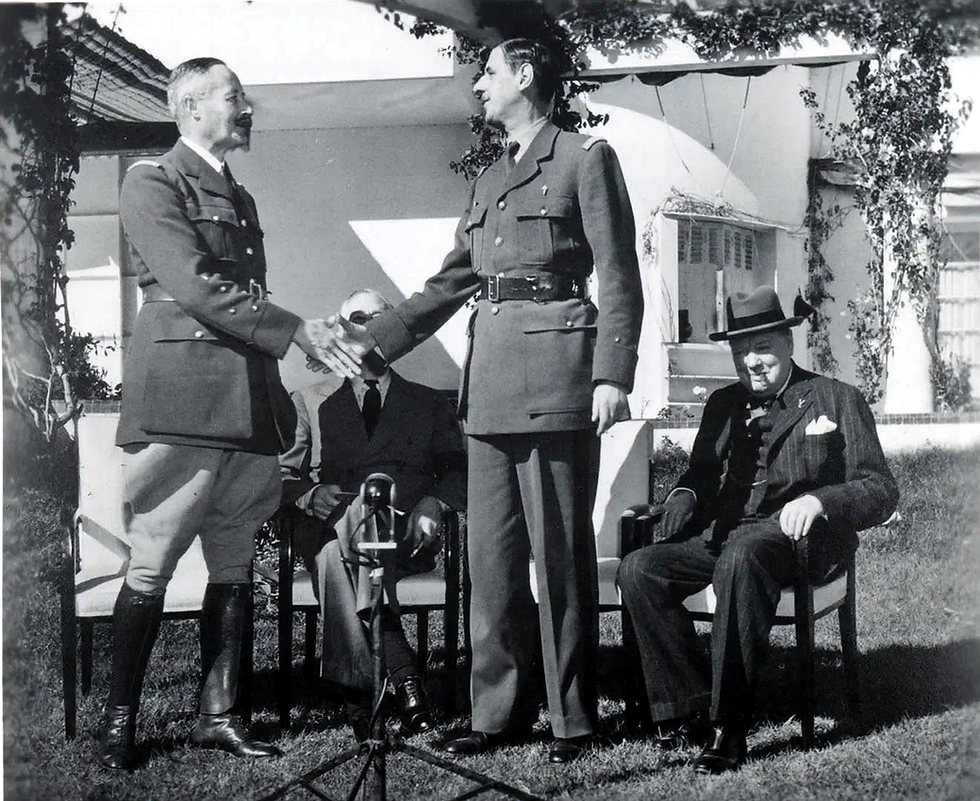
Between the 14th and 24th of January 1943, Allied leaders met at the Anfa Hotel in Casablanca, Morocco, for one of the most significant strategic conferences of the Second World War. The meeting brought together U.S. President Franklin D. Roosevelt and British Prime Minister Winston Churchill, alongside representatives of Free France, Charles de Gaulle and Henri Giraud. Joseph Stalin, leader of the Soviet Union, was invited but declined to attend due to the ongoing Battle of Stalingrad. Though less dramatic than later summits at Tehran or Yalta, Casablanca was a decisive moment in shaping Allied grand strategy and defining the political terms on which the war would be ended.

Casablanca was chosen for both symbolic and practical reasons. Recently secured by Allied forces during Operation Torch, it offered a safe location within reach of the Mediterranean theatre. For Roosevelt, the journey itself mattered. His presence sent a clear message: the United States was now fully committed to leading the Allied war effort. Churchill welcomed Roosevelt warmly. The two leaders had already developed a close working relationship, and Casablanca offered a chance to solidify Anglo-American relations and align strategy at a critical moment.
The French question proved more problematic: Charles de Gaulle, deeply distrustful of Allied intentions and resentful of Giraud’s elevation, arrived only on 22 January after repeated refusals. Under intense pressure, the Allies imposed a compromise that established joint leadership of the Free French forces, a reluctant arrangement Roosevelt famously described as a "shotgun wedding".
In early 1943, Allied strategy was unbalanced. The Red Army was engaged in a desperate struggle against the Wehrmacht, while Britain and the United States had yet to confront German forces on the European mainland. Although the Allied landings in North Africa in November 1942 were successful, they did little to prevent Germany from reinforcing the Eastern Front. Stalin made his position clear: only the opening of a second front in Western Europe would force Hitler to divert troops from the Soviet Union. Roosevelt was sympathetic, favouring an early cross-Channel invasion of France as the most direct way to defeat Germany and relieve pressure on the Soviets.
Churchill, however, remained unconvinced. He argued that the Allies lacked the landing craft, manpower, and logistical preparation for such an operation in 1943, and instead pressed for a Mediterranean strategy, known as the “underbelly” approach. The conference confirmed plans for Operation Husky, the invasion of Sicily, to be followed by an advance into Italy. These operations aimed to secure Mediterranean supply routes, destabilise Mussolini’s regime, and draw German forces away from the Eastern Front. A cross-Channel invasion was postponed until 1944, a decision later formalised at the Trident Conference in Washington.
For Stalin, this delay was deeply disappointing, and to compensate, the Western Allies sought other ways to increase pressure on Germany. The Battle of the Atlantic dominated discussions, as German U-boats continued to threaten the supply lines that sustained Britain and the Soviet Union.
At the same time, the Allies agreed to intensify the Combined Bomber Offensive, committing British and American air forces to round-the-clock bombing of German industrial and military targets. The conference also reaffirmed a “Germany First” approach, even as the United States increased its commitments in the Pacific War against Japan.
The most famous, and controversial, outcome of Casablanca came when Roosevelt announced that the Allies would accept nothing less than "unconditional surrender" from the Axis powers. The policy was intended to prevent a repeat of the First World War, when Germany claimed it had not been fully defeated. Unconditional surrender meant total disarmament, the destruction of militarism, and accountability for war crimes.
Churchill later clarified the policy in Parliament, insisting that it did not mean that the German people would be "enslaved or destroyed". Rather, it meant that the Allies would have “a free hand” to ensure Germany could never again threaten European peace. Critics later argued that the policy may have had unintended consequences. By eliminating any possibility of negotiation, unconditional surrender may have strengthened German resolve and discouraged internal opposition to Hitler.
The conference concluded on a lighter note. Roosevelt and Churchill travelled on to Marrakesh, where they explored the city and allowed themselves a brief moment of respite. It was there that Churchill famously insisted Roosevelt watch the sunset over the Atlas Mountains. In that shared pause, far from the maps and memoranda of war, it felt like the beginning of a beautiful friendship. After Roosevelt’s departure, Churchill painted a scene of Marrakesh the following day and sent it to him as a memento - a gesture that was as personal as it was political.

Having resolved the fundamental questions of Allied strategy, the leaders parted with a shared commitment to a long, carefully prepared struggle. By choosing patience over haste and total victory over compromise, the decisions made at Casablanca shaped the final two years of the war and the post-war world that emerged from it.




Comments